Subjects

Tuesday, April 21, 2015

Bridge(t)

Urban Planning is the third and final class in the STEAM Global Design curriculum. The class, in a nutshell, is about how to create an ecosystem fit for a city. In the first unit we learned how an architectural structure can hold large amounts of weight by focusing on bridges. The main objective of this action project is to explore the various design options and resources to create a durable bridge. I’m most proud of the bridge (Bridget) that my partner and I built because everyone doubted us, but in the end our design did exactly what is was supposed to and more.

The bridge that inspired me and my partner was the Gazela Bridge. Our model resembles the Gazela Bridge because it is a flat and straight structure and looks like it has three layers just like our bridge.

Wikipedia contributors. "Gazela Bridge." Wikipedia, The Free Encyclopedia. Wikipedia, The Free Encyclopedia, 7 Mar. 2014. Web. 20 Apr. 2015.
The Gazela Bridge is the most important bridge in Belgrade, Serbia, across the Sava river. It is a part of the city highway and passes through the wider city center, connecting Belgrade with Niš to the south, and Novi Sad to the north. The bridge was designed by a group of engineers led by Milan Đurić, and built by the Mostogradnja company.

Our bridge is very simple and to the point. It is your basic straight across, flat, beam bridge. At first glance it’s very deceiving, but our bridge divides the strength along its length, leaving no room for weak links where the bridge can collapse. 

Bridge Sketch (2015)
The scale in the image above only applies to the length, but 1 inch on the drawing equals 1.8 inches on the model. We only made the length to scale because we wanted to be able to show the layers, but the popsicle sticks are so thin they would just be drawn as lines, which isn’t very clear.

AG Labeled Picture (2015)

AG Compression and Tension (2015)
AG Body Diagram (2015)
Our final product ended up using only 49 popsicle sticks. Our bridge is 13.375 inches long and 625 inches tall. It is 180 degrees across (a straight angle).

AG Side View (2015)

AG Top View (2015)
We came up with our structure because we knew that with the length and amount of popsicle sticks given, this was the thickest possibility for the body of the bridge. We thought that the thicker it would be the more weight it would hold. After building our original design, we had an extra 5 sticks left, and we decided to use 4 of those 5 leftover sticks to make the joints sturdier.

The main problem we encountered were the joints, because if they were all to be in the same place they could easily snap. We fixed this by shifting the middle layer so it had joints in a different position on the bottom and top layer, and we also the used 4 extra sticks, which we cut in half, to strengthen the top and bottom layers’ joints.

Work Cited
  • "Bridges - WD-STEM." Bridges - WD-STEM. Buncombe County Schools. Web. 21 Apr. 2015 from https://sites.google.com/a/bcsemail.org/wdstem/bridges. 
  • "New York State Covered Bridges - Truss Diagrams." New York State Covered Bridges - Truss Diagrams. 30 Sept. 2005. Web. 20 Apr. 2015 from http://www.coveredbridgesite.com/ny/truss.html.
  • Wikipedia contributors. "Gazela Bridge." Wikipedia, The Free Encyclopedia. Wikipedia, The Free Encyclopedia, 7 Mar. 2014. Web. 20 Apr. 2015 from http://en.wikipedia.org/wiki/Gazela_Bridge.

Thursday, March 19, 2015

The Clock for Everyone

For our final Light and Sound unit we learned about time. We found out about time works, how it is measured, how the world started, and much more. We then focused on methods of telling time and learned about pendulums, sundials, geographic coordinates, etc. For our action project we were challenged to design a unique clock. I’m proud of the type of clock I invented, because it is to help people with disabilities which I think is important.

On the FE our class went on, to the Chicago Light House, something one of the head people of the organization said, stuck with me. He said "Blind people can do anything, as long as you give them a chance." So this was my way of trying to give them a chance to do something new.


Work Cited

-Aftelier Natural Perfume Wheel." Essential Oil UniversityRSS. Web. 16 Mar. 2015.

-Goodrich, Ward. "The Modern Clock; a Study of Time Keeping Mechanism; Its Construction, Regulation, and Repair : Goodrich, Ward L : Free Download & Streaming : Internet Archive." Internet Archive. Web. 16 Mar. 2015.

- Falcon, A. (n.d.). 20 Alarm Clocks To Wake You Up Creatively. Retrieved March 16, 2015, from http://www.hongkiat.com/blog/creative-alarm-clocks/

Church And State

For our final Argument unit we learned about contradictions in arguments as well as how to find them and fix them. We continued our focus on the United States Constitution, especially issues related to civil rights, and found many flaws, in our opinion. Each of us chose an important issue to focus on and share our beliefs on, as well as how people disagreeing with our beliefs feel. In this unit I was most proud of this Action Project because I think it covers an important topic that is highly unjust.

Thesis
The topic I chose focused on the separation of church and state, and for the US to follow through on its own church-state separation laws. This is important to me because I know people of all religions who are Americans and I believe it’s unfair to them to not uphold these laws, not only because it goes against the 1st Amendment’s protection of freedom of [any] religion, but also because it clearly prioritizes and embraces Christianity. There are multiple cases showing this: many public schools still require their students to recite the Pledge of Allegiance, part of which includes pledging themselves to “one nation, under God”, and the Star-Spangled Banner, which has a line stating “and this be our motto, In God we trust." It even says “In God We Trust” on the dollar bill. All of these examples go against many cultural beliefs and against the 1st Amendment. Not only do some people not believe in a god at all, but certain religions aren’t allowed to swear themselves to another supreme being.

On the other side of things, even some Christians don’t want their religious beliefs being included in state’s rights. For example, the Jehovah Witnesses objected to adding “under God” since they won't swear patriotic or other oaths. So, both non-Christians and some Christians even don’t agree with this law not being followed through.

Antithesis
However, on the other side of things some people, predominantly Christians, may argue that “religious viewpoints are inherently embedded into the political system,” claiming it is detrimental to keep the two together. They believe not only that it is crucial in politics, but that changing the way things are would be taking away their freedom of religion.

Synthesis
People who don’t want anything to change ask how things would change if we suddenly enforced this more. The people who want this change ask how is it fair to have such a clear preference of Christianity when America is for people of all religions? Both sides have the same main argument claiming that this is simply their way of expressing the first amendment; however after the research I’ve done, I still believe the government should stick more strongly to its own law about Church and State. I still don’t think they should be favoring one, which they clearly do to this day.

Pro Life on Campus: A First Amendment seminar (2015)

Evidence of Dialect
Work Cited
  • Pledge of Allegiance. (n.d.). Retrieved March 17, 2015, from http://en.wikipedia.org/wiki/Pledge_of_Allegiance
  • Separation of church and state in the United States. (n.d.). Retrieved March 17, 2015, from http://en.wikipedia.org/wiki/Separation_of_church_and_state_in_the_United_States
  • State/Church FAQ. (n.d.). Retrieved March 17, 2015, from http://ffrf.org/outreach/item/14030-pledge-of-allegiance
  • Tyler, J. (2012, November 14). Church and state must coexist, not remain separate. Retrieved March 17, 2015, from http://kykernel.com/2012/11/14/church-and-state-must-coexist-not-remain-separate/

Tuesday, March 10, 2015

GCE Protection

In our second unit of Argument we learned more about more what makes an argument and about different flaws and contradictions. We studied the US Constitution, and then looked at GCE's Code of Conduct and found all the flaws we could in the document. We then chose a policy and revised, giving our view on the issue. I was proud of the FE I helped make happen in this Unit; it was the closing argument of a trial, and I personally thought it was really interesting to get to see in real life.

The part of the Code of Conduct that I would like to change is the policy:

“Weapons: The possession of any weapons, tools, or objects to threaten the well-being of others (including firearms, knives, etc.) or poses a severe threat to the safety of the entire community. The DC reserves the right to suspend or dismiss a student for an offense which endangers life or health, or poses a special threat to any member of our School community.”

The argument supporting this rule is :
P1: Weapons can hurt people.
P2: Weapons are dangerous.
P3: School is meant to be a safe environment.
C: Weapons shouldn’t be allowed in schools.

The reason I think this should be changed is because of students’ circumstances. Some students may not feel safe without some form of protection, such as a pocket knife or mace. Some students live in bad neighborhoods and don’t feel safe walking home alone without anything. The rule says you can’t possess any sort of weapon, but I think this should be changed to not taking out, using, or threatening to use any sort of weapon that you possess. As long as students aren’t posing a threat to other GCE students or faculty, they should be allowed to possess something to make them feel safe. Students will not be allowed to take out their weapons during school, or make threats with it to any GCE student or staff member, and if they do this privilege will be revoked from them, and the only way they will be allowed to continue bringing a weapon is if they turn it in at the beginning of the day.

Many students live in unsafe areas, and allowing them to carry a weapon with them could stop a lot of bad from happening. These weapons, used for self-defense, are like a key, unlocking the door to safety. They could save a students’ life or prevent a student from getting raped. According to an article “Stranger kidnapping victimizes more females than males, occurs primarily at outdoor locations, victimizes both teenagers and school-age children, is associated with sexual assaults in the case of girl victims and robberies in the case of boy victims (although not exclusively so)” (Bilich). Another report asserts that: “1 in 6 endangered runaways reported to the National Center for Missing & Exploited Children in 2014 were likely sex trafficking victims” (Key Facts). Issues like this could be eliminated if a safety weapon were to be carried. GCE doesn’t want any harm coming to their students, and to help make sure our students don’t add to statistics like the ones above, they should be allowed to carry a weapon.

One of our students, MV, stated “I think weapons should be allowed because a lot of students live in bad neighborhoods and feel unsafe walking home alone, and should be allowed something to make them feel safer.” A number of students feel this way, and it is the school’s responsibility to help make them feel safer.

Furthermore, this directly relates to the Second Amendment of the US Constitution- the right to keep and bear arms. This is pretty much the same argument as my amendment, that weapons should be allowed for safety. It protects our right to protect ourselves, and to possess weapons for our own safety.

In conclusion, my argument is that:
P1: Some students travel through unsafe areas before/after school.
P2: Weapons provide a self-defense method and protection.
P3: Students will be safer walking in dangerous areas, with a weapon.
C: Students should be allowed to possess weapons on campus, if they want to, in order to feel safe.

The following video shows what other Chicago students go through in order to safely get to school:

    l
Work Cited:
-Bilich, Karin A. "Child Abduction Facts." Parents Magazine. Web. 10 Mar. 2015.<http://www.parents.com/kids/safety/stranger-safety/child-abduction-facts/>.
-"Key Facts." National Center for Missing & Exploited Children. Web. 10 Mar. 2015. <http://www.missingkids.com/KeyFacts>.
-"A Dangerous Walk to School." YouTube. YouTube. Web. 10 Mar. 2015. <https://www.youtube.com/watch?v=2h2Yytecex0>.

Wednesday, March 4, 2015

LEGO Guitar

In our second Light & Sound unit we learned about what sound is, how it is made and heard, how it travels, and other fundamentals of sound. I am most proud of the science concepts learned such as how to graph sound waves and learning what each variable stood for. Our action project is about about creating sound waves and making an instrument that can be played by the Landfill Harmonic. We were each instructed to build a guitar from scratch. This would show how sound is produced and amplified.

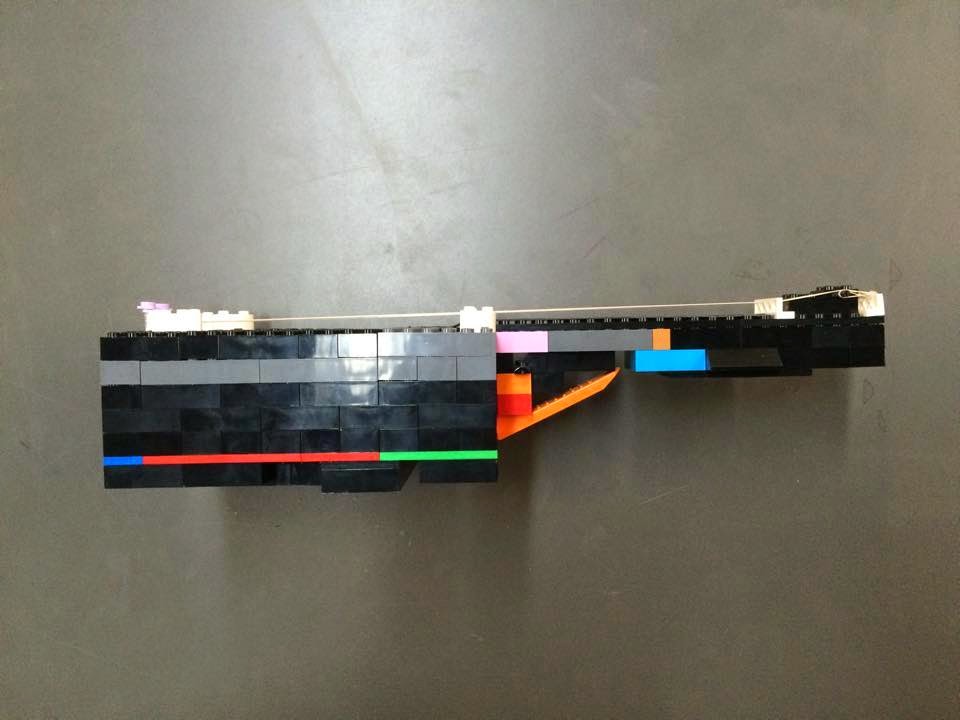
The guitars we built work like a normal guitar: the strings vibrate the air, and the body amplifies the vibrations, projecting a louder sound. When you press on the strings you change the length of the vibrating which changes the pitch. The lower on the neck you go the higher the pitch.

The sounds the guitar makes show all the principles we learned. Sound waves are molecules contracting and expanding, which is shown on the guitar with the vibrating strings. They make vibrations in the air which are just contracting and expanding molecules. Wavelength is the distance from one peak/crest/trough to the next peak/crest/trough. The shorter the guitar string length the shorter the wavelength. Pitch/frequency is how fast a wave travels (how many cycles there are per second). Each string has a different pitch, and if you change the length of the string by putting your finger down, it will change the pitch. Amplitude is how high/low the wave is, the guitar’s body demonstrates this by amplifying the sound the strings make.The amplitude is how loud the sound is, the higher the amplitude, the louder the sound is.

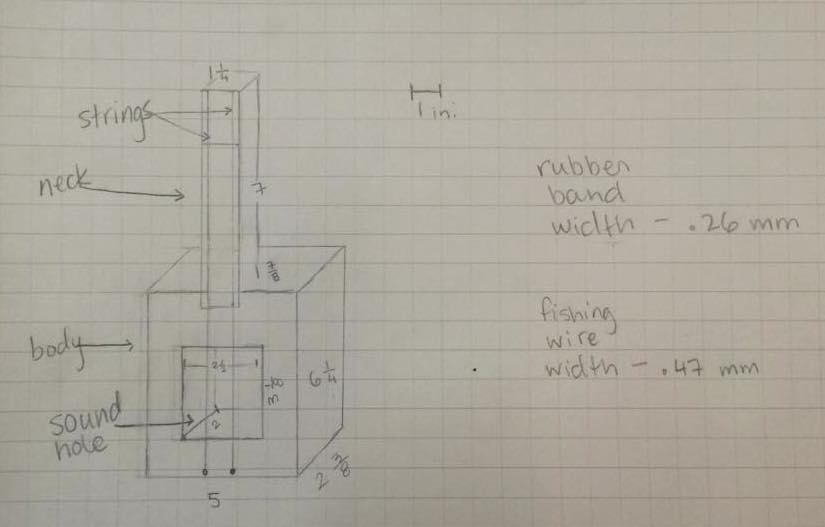
All the dimensions are shown in the picture below. The rubber band width was .26 mm and the fishing wire width was .47mm. The volume of the body was 74 7/32 squared inches and the volume of the sound hole was 15 5/8 squared inches.

AG Guitar Sketch (2015)
After building the guitar we also found the frequencies and wavelengths of the open notes and the octave notes of both strings. The rubber band string was a G note, the open note frequency was 403.4 Hz and the wavelength was 185.8 cm, the octave note frequency was 806.8 Hz and the wavelength was 92.9 cm.The fishing wire string was an A# note, the open note frequency was 455.9 Hz and the wavelength was 657.6 cm, the octave note frequency was 911.8 Hz and the wavelength was 328.8 cm.
AG Guitar Front (2015)
AG Guitar Side (2015)
Another thing we learned about in this unit was the Doppler Effect; this is the phenomenon that makes a sound’s pitch seem to get higher as it travels towards you and lower as it travels away from you. Really the pitch stays the same the whole time, but it sounds like it changes because the waves get pushed together and overlap when the sound is moving towards you, and spread out when moving away from you.

I really enjoyed this action project and had fun making the guitar. However, if I could do this project again I would add more strings and add tuning pegs so I could change the tension of the strings as well. That way it would be even more like a real guitar.

Tuesday, February 17, 2015

The 101 About Law 101

Our Argument class is all about the logic skills needed to analyze, develop, and sustain an argument. In our first unit we learned about the fundamental elements of an argument and the types of reasoning. I am proud of my understanding of the Venn Diagrams we did for homework and in class. We learned all the key concepts that make an argument and for our first action project we had to put these concepts to use by writing a course or independent study proposal.

At GCE, we are supposed to learn things that will benefit us in the real world. The school teaches what they consider to be the four principal values of global citizenship that form a durable foundation for achievement: accountability, purpose, autonomy, and gratitude. The school’s website claims that the education they provide, “Equips students to thrive in today’s complex world.” To achieve this goal, GCE offers a curriculum that is based around a hands-on educational experience where students take the concepts they learn in school and apply them to the real world as opposed to the more ordinary approach to education that most high schools provide. They already manage to do this quite well, but I believe with the course I have in mind, they could accomplish it even better. It is our right as students to be taught subject matter that will prepare us for when we are outside of school. I believe this requires a knowledge of our rights, not just as students, but as American citizens.

The course that I would like to propose is a Law class with the guiding question: what rights do we all have? It would take place during the fall term of senior year. The reason I chose this term is because the other course seniors take during that time is Economics, which involves topics such as taxes, which I think would tie into a law class. Taxes are a part of the law and there are many tax laws that must be followed. If students learn the laws about taxes along with the math concepts, they will understand their tax responsibilities better.

What are GCE’s goals? To prepare students for the real world. Adding this law class will increase the success of that goal, greatly. It is important to have a class about law because every citizen, no matter what age, should know his/her rights. This information is really practical, and could be helpful at any point in one's life. Also, senior year is when most students turn 18, which means they are legally adults and can now vote. This makes learning the laws even more crucial, especially if they will be leaving for college and going to be on their own for the first time. This class would prepare you for going into the “real world” and would benefit you your whole life.

Law 101 would take place on-site at GCE’s campus, and would be partnered with the law firm Baker & McKenzie, which has hundreds of lawyers practicing in every field of law. It is an international law firm headquartered in Chicago, and it would be the perfect firm to partner with because they don’t just have one specialty in law, they have lawyers in all the fields, so they could give us a wider range of education about the law. The class would also need a copy of the Constitution of the United States, the Illinois Constitution, and the law textbook, Introduction to Law and the Legal System by Frank August Schubert, to get some key points. They would also watch the films A Few Good Men and My Cousin Vinny to see the skills they learn put in action and to see that any type of person can be put in both the position of an attorney or the person on trial.

The content of the class includes some education in US History, the law, as well as debate skills. These are all important because GCE does not yet have a class that teaches us, strictly, American History and it is important to be educated about it, because it is famously said that those who don’t learn their history are destined to repeat past mistakes. The history part would focus mostly on the judicial branch of government which is based on precedent going back to the origins of the country. The laws would obviously be crucial to learning in this course since it is a law class, and debate skills are important because even outside of law, these skills help you make your voice heard and present your position, no matter what you're arguing for or against, in a logical manner.

Some of the FEs for students of Law 101 would be to different law firms such as the one we are partnered with, as well as court houses. This will allow them to see how these skills are applied in the real world and what happens to people who broke laws because they were uneducated about them. One of the Action Projects the students would have, would be a mock trial or debate. This would be done in pairs and the roles would be the defense and the other would be the prosecution, or if they chose to do a debate simply the two opposing sides. Another Action Project would be writing a persuasive paper about why they disagree with or how they would change an existing law, or what  law would they like to add. The third project would be a video project teaching what to do in certain situations involving law/police.

P1: GCE's four values are: accountability, purpose, autonomy, and gratitude.
P2: Cultivating these four values prepares you for the real world.
P3: All citizens should know their rights and the laws.
P4: Knowing your rights and the laws prepares you for the real world.
C: GCE should offer a law class.


The goal for this course is for every student to understand the law, learn what their rights are, and how to exercise them. If this course is added, it will make a vast difference in students’ lives and their preparation for being on their own. GCE will be accomplishing their goals better than ever, and will truly be helping their students. I hope Law 101 will be taken into consideration.


Works Cited

  • Home. (2013, June 20). Retrieved February 16, 2015, from http://gcelabschool.com/ 
  • Introduction to Law and the Legal System Hardcover. (2014, January 1). Retrieved February 16, 2015, from http://www.amazon.com/Introduction-Legal-System-August-Schubert/dp/1285438256/ref=dp_ob_image_bk
  • Baker & McKenzie. (n.d.). Retrieved February 16, 2015, from http://www.bakermckenzie.com/

Wednesday, February 11, 2015

Pin the Hole on the Camera

Our Light and Sound course is about, as stated, light and sound but also time, and how they all relate. It has to do with our perspective on the world and how it would be different if those three elements were different. Our first unit is Light where we discussed how light affects us and how we are able to see it. We learned about how we see light with our eyes, and how cameras make photos with a similar process. We also learned about lenses and the visible spectrum and many other things having to do with vision. I’m most proud of the science parts I learned in this class since it isn’t my strong suit.

For our action project we made pinhole cameras. A pinhole camera is pretty simple: you choose an object, such as a shoe box, that is completely black on the inside, and cut a hole in it. You then place a sanded down piece of tin with a tiny hole poked in it that acts as a lens. The light will shine through that lens when you uncover it, and when there is photo-sensitive paper inside, it will a picture will appear based on the light that comes through the lens.

AG Inside Pinhole Camera (2015)
AG Pinhole Camera (2015)


The math concept we used for this project was similar triangles.


x^2+y^2=z^2                             a^2+b^2=c^2                             

1 15/16^2+11 1/2^2 = 136^2     4 3/4^2+16 43/62^2 = 302.24^2

   z = 11.66                                   c =17.36                                     


The height of my pinhole is x which equals 1 15/16 inches
The distance from the lens to my paper is y which equals 11 ½ inches
The height of my subject is a which equals 4 ¾ inches
The distance from the back of my camera to my object is b+y which equals 28 6/31 inches
The distance from the lens to my object is b which equals 16 43/62 inches

The shutter speed that I tried the first time was 2 minutes and the second time was 4 minutes. Unfortunately the pictures didn’t show up because the pinhole wasn’t the right size, it was a little too small so the light didn’t come through enough. If I were to get a chance to redo the project I would make sure to fix that mistake.

JS Pinhole (2015)

This project shows the relationship between light and energy because when the light makes touches the paper it causes it to change color, which shows that is transferred its energy to it. I didn’t however think that the camera illustrated the idea of refraction because there wasn’t anything like water that would slow down the light, there was only air. Refraction involves light slowing down and bending so if that didn’t happen, refraction wasn’t shown.
As an addition we got to make photograms.This also involves using light sensitive paper, however you don’t use the camera and the pictures show up differently.


AG Photogram (2015)