Subjects

Wednesday, March 4, 2015

LEGO Guitar

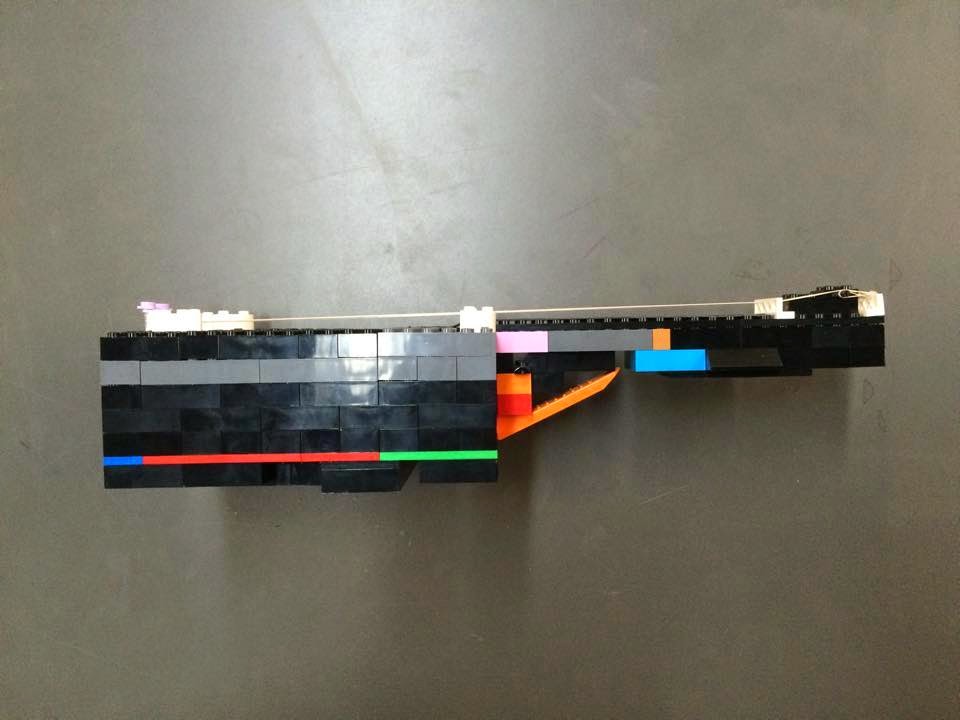
In our second Light & Sound unit we learned about what sound is, how it is made and heard, how it travels, and other fundamentals of sound. I am most proud of the science concepts learned such as how to graph sound waves and learning what each variable stood for. Our action project is about about creating sound waves and making an instrument that can be played by the Landfill Harmonic. We were each instructed to build a guitar from scratch. This would show how sound is produced and amplified.

The guitars we built work like a normal guitar: the strings vibrate the air, and the body amplifies the vibrations, projecting a louder sound. When you press on the strings you change the length of the vibrating which changes the pitch. The lower on the neck you go the higher the pitch.

The sounds the guitar makes show all the principles we learned. Sound waves are molecules contracting and expanding, which is shown on the guitar with the vibrating strings. They make vibrations in the air which are just contracting and expanding molecules. Wavelength is the distance from one peak/crest/trough to the next peak/crest/trough. The shorter the guitar string length the shorter the wavelength. Pitch/frequency is how fast a wave travels (how many cycles there are per second). Each string has a different pitch, and if you change the length of the string by putting your finger down, it will change the pitch. Amplitude is how high/low the wave is, the guitar’s body demonstrates this by amplifying the sound the strings make.The amplitude is how loud the sound is, the higher the amplitude, the louder the sound is.

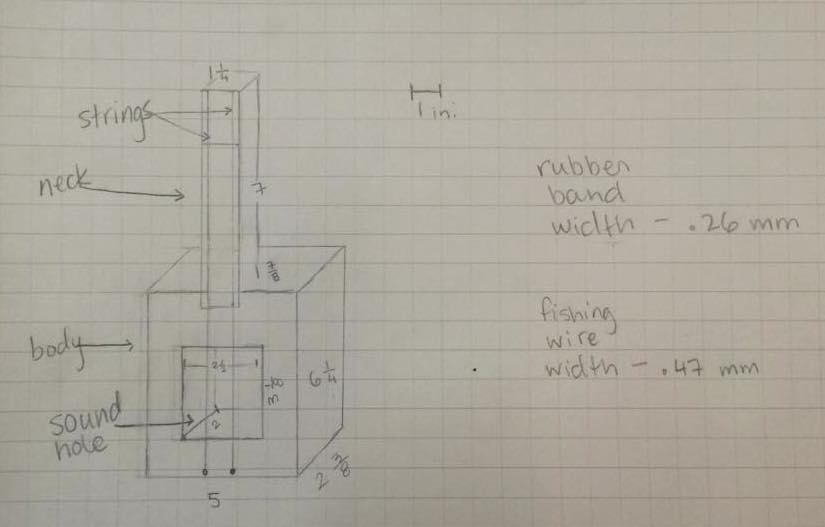
All the dimensions are shown in the picture below. The rubber band width was .26 mm and the fishing wire width was .47mm. The volume of the body was 74 7/32 squared inches and the volume of the sound hole was 15 5/8 squared inches.

AG Guitar Sketch (2015)
After building the guitar we also found the frequencies and wavelengths of the open notes and the octave notes of both strings. The rubber band string was a G note, the open note frequency was 403.4 Hz and the wavelength was 185.8 cm, the octave note frequency was 806.8 Hz and the wavelength was 92.9 cm.The fishing wire string was an A# note, the open note frequency was 455.9 Hz and the wavelength was 657.6 cm, the octave note frequency was 911.8 Hz and the wavelength was 328.8 cm.
AG Guitar Front (2015)
AG Guitar Side (2015)
Another thing we learned about in this unit was the Doppler Effect; this is the phenomenon that makes a sound’s pitch seem to get higher as it travels towards you and lower as it travels away from you. Really the pitch stays the same the whole time, but it sounds like it changes because the waves get pushed together and overlap when the sound is moving towards you, and spread out when moving away from you.

I really enjoyed this action project and had fun making the guitar. However, if I could do this project again I would add more strings and add tuning pegs so I could change the tension of the strings as well. That way it would be even more like a real guitar.

Tuesday, February 17, 2015

The 101 About Law 101

Our Argument class is all about the logic skills needed to analyze, develop, and sustain an argument. In our first unit we learned about the fundamental elements of an argument and the types of reasoning. I am proud of my understanding of the Venn Diagrams we did for homework and in class. We learned all the key concepts that make an argument and for our first action project we had to put these concepts to use by writing a course or independent study proposal.

At GCE, we are supposed to learn things that will benefit us in the real world. The school teaches what they consider to be the four principal values of global citizenship that form a durable foundation for achievement: accountability, purpose, autonomy, and gratitude. The school’s website claims that the education they provide, “Equips students to thrive in today’s complex world.” To achieve this goal, GCE offers a curriculum that is based around a hands-on educational experience where students take the concepts they learn in school and apply them to the real world as opposed to the more ordinary approach to education that most high schools provide. They already manage to do this quite well, but I believe with the course I have in mind, they could accomplish it even better. It is our right as students to be taught subject matter that will prepare us for when we are outside of school. I believe this requires a knowledge of our rights, not just as students, but as American citizens.

The course that I would like to propose is a Law class with the guiding question: what rights do we all have? It would take place during the fall term of senior year. The reason I chose this term is because the other course seniors take during that time is Economics, which involves topics such as taxes, which I think would tie into a law class. Taxes are a part of the law and there are many tax laws that must be followed. If students learn the laws about taxes along with the math concepts, they will understand their tax responsibilities better.

What are GCE’s goals? To prepare students for the real world. Adding this law class will increase the success of that goal, greatly. It is important to have a class about law because every citizen, no matter what age, should know his/her rights. This information is really practical, and could be helpful at any point in one's life. Also, senior year is when most students turn 18, which means they are legally adults and can now vote. This makes learning the laws even more crucial, especially if they will be leaving for college and going to be on their own for the first time. This class would prepare you for going into the “real world” and would benefit you your whole life.

Law 101 would take place on-site at GCE’s campus, and would be partnered with the law firm Baker & McKenzie, which has hundreds of lawyers practicing in every field of law. It is an international law firm headquartered in Chicago, and it would be the perfect firm to partner with because they don’t just have one specialty in law, they have lawyers in all the fields, so they could give us a wider range of education about the law. The class would also need a copy of the Constitution of the United States, the Illinois Constitution, and the law textbook, Introduction to Law and the Legal System by Frank August Schubert, to get some key points. They would also watch the films A Few Good Men and My Cousin Vinny to see the skills they learn put in action and to see that any type of person can be put in both the position of an attorney or the person on trial.

The content of the class includes some education in US History, the law, as well as debate skills. These are all important because GCE does not yet have a class that teaches us, strictly, American History and it is important to be educated about it, because it is famously said that those who don’t learn their history are destined to repeat past mistakes. The history part would focus mostly on the judicial branch of government which is based on precedent going back to the origins of the country. The laws would obviously be crucial to learning in this course since it is a law class, and debate skills are important because even outside of law, these skills help you make your voice heard and present your position, no matter what you're arguing for or against, in a logical manner.

Some of the FEs for students of Law 101 would be to different law firms such as the one we are partnered with, as well as court houses. This will allow them to see how these skills are applied in the real world and what happens to people who broke laws because they were uneducated about them. One of the Action Projects the students would have, would be a mock trial or debate. This would be done in pairs and the roles would be the defense and the other would be the prosecution, or if they chose to do a debate simply the two opposing sides. Another Action Project would be writing a persuasive paper about why they disagree with or how they would change an existing law, or what  law would they like to add. The third project would be a video project teaching what to do in certain situations involving law/police.

P1: GCE's four values are: accountability, purpose, autonomy, and gratitude.
P2: Cultivating these four values prepares you for the real world.
P3: All citizens should know their rights and the laws.
P4: Knowing your rights and the laws prepares you for the real world.
C: GCE should offer a law class.


The goal for this course is for every student to understand the law, learn what their rights are, and how to exercise them. If this course is added, it will make a vast difference in students’ lives and their preparation for being on their own. GCE will be accomplishing their goals better than ever, and will truly be helping their students. I hope Law 101 will be taken into consideration.


Works Cited

  • Home. (2013, June 20). Retrieved February 16, 2015, from http://gcelabschool.com/ 
  • Introduction to Law and the Legal System Hardcover. (2014, January 1). Retrieved February 16, 2015, from http://www.amazon.com/Introduction-Legal-System-August-Schubert/dp/1285438256/ref=dp_ob_image_bk
  • Baker & McKenzie. (n.d.). Retrieved February 16, 2015, from http://www.bakermckenzie.com/
Wednesday, February 11, 2015

Pin the Hole on the Camera

Our Light and Sound course is about, as stated, light and sound but also time, and how they all relate. It has to do with our perspective on the world and how it would be different if those three elements were different. Our first unit is Light where we discussed how light affects us and how we are able to see it. We learned about how we see light with our eyes, and how cameras make photos with a similar process. We also learned about lenses and the visible spectrum and many other things having to do with vision. I’m most proud of the science parts I learned in this class since it isn’t my strong suit.

For our action project we made pinhole cameras. A pinhole camera is pretty simple: you choose an object, such as a shoe box, that is completely black on the inside, and cut a hole in it. You then place a sanded down piece of tin with a tiny hole poked in it that acts as a lens. The light will shine through that lens when you uncover it, and when there is photo-sensitive paper inside, it will a picture will appear based on the light that comes through the lens.

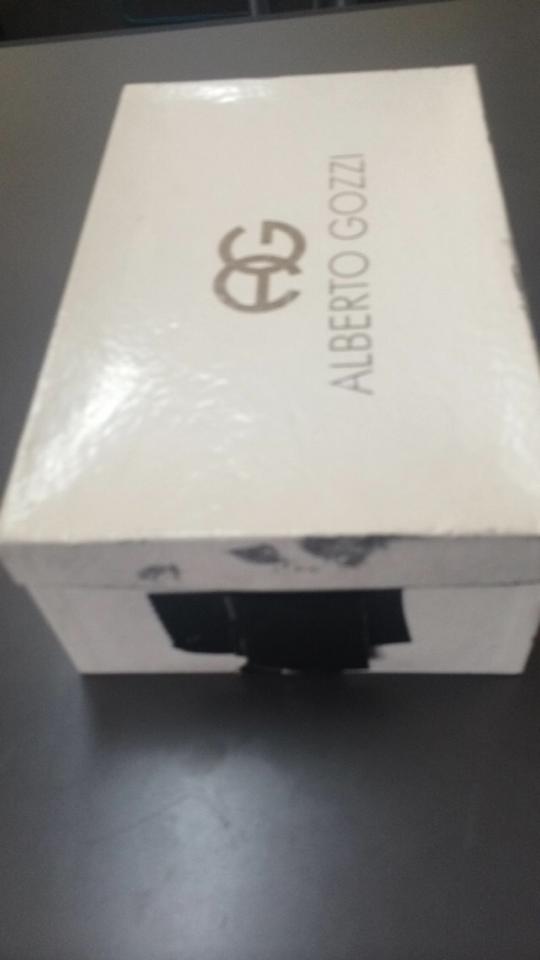
AG Inside Pinhole Camera (2015)
AG Pinhole Camera (2015)


The math concept we used for this project was similar triangles.


x^2+y^2=z^2                             a^2+b^2=c^2                             

1 15/16^2+11 1/2^2 = 136^2     4 3/4^2+16 43/62^2 = 302.24^2

   z = 11.66                                   c =17.36                                     


The height of my pinhole is x which equals 1 15/16 inches
The distance from the lens to my paper is y which equals 11 ½ inches
The height of my subject is a which equals 4 ¾ inches
The distance from the back of my camera to my object is b+y which equals 28 6/31 inches
The distance from the lens to my object is b which equals 16 43/62 inches

The shutter speed that I tried the first time was 2 minutes and the second time was 4 minutes. Unfortunately the pictures didn’t show up because the pinhole wasn’t the right size, it was a little too small so the light didn’t come through enough. If I were to get a chance to redo the project I would make sure to fix that mistake.

JS Pinhole (2015)

This project shows the relationship between light and energy because when the light makes touches the paper it causes it to change color, which shows that is transferred its energy to it. I didn’t however think that the camera illustrated the idea of refraction because there wasn’t anything like water that would slow down the light, there was only air. Refraction involves light slowing down and bending so if that didn’t happen, refraction wasn’t shown.
As an addition we got to make photograms.This also involves using light sensitive paper, however you don’t use the camera and the pictures show up differently.


AG Photogram (2015)

Saturday, January 17, 2015

All About Indiana


Director: Steven Spielberg
Film Editor: Michael Khan and George Lucas (uncredited)

Directed by Steven Spielberg, Indiana Jones: Raiders of the Lost Ark, is an incredible action-adventure movie released on June 12, 1981. The movie is about an archaeologist and professor, Indiana Jones, played by Harrison Ford, who gets hired by the Army Intelligence during (1936 which was a few years before the starts of WWII) to find an old ancient artifact- the Ark of the Covenant- before the Nazis get their hands on it. The movie is about the crazy adventure he goes through to get it, with the help of his friends and romantic interest Marion, played by Karen Allen. In the end, the Ark destroys the Nazis, Indiana returns it to Army Intelligence, and it gets sealed up and safely stored away.

The movie had many cultural aspects to it. There are parts relating the Bible to the meaning behind ancient religious artifacts. It shows the audience what many cultures and religious groups believed during different time periods. Religion is something that many different people can relate to, so it makes sense why they would use a religious artifact as the important item in the movie. The film also shows the audience how Nazis were, or at least how they were portrayed, during the time the movie takes place in. Ever since WWII Nazis were pretty much know as the enemy all over the world. It made sense for them to use Nazis in this movie because they were considered a threat, and during their time in power they wanted to find historical artifacts to help support their claim of racial superiority. So they had a reason to want the Ark and have Indiana as an enemy. Another culture the movie shines light on, is of the people living in Cairo. It shows how they dress, how their homes are, how they work, how they react to crime, and in general how they live. It shows you an entire different side of the world and is really interesting to see as an American. Cairo was chosen as the city for this movie because in real life, research done about the Ark shows that it was in Cairo at some point.

The movie had many exceptional elements beginning with the editing. One of my favorite scenes is towards the beginning when Indiana Jones had just run out of the Temple. The camera goes from a close-up view of him, where you see Indiana’s eyes look up, and the screen cuts to a look-off of a native with an arrow to show you what Indiana is seeing. It then cuts from one native to another. The audio linkage is also used first when the bad man is talking, and again when he is laughing and the screen goes from him to Indiana running. Furthermore, they used dialogue referent when he yells to start the engine, and the screen cuts to the plane. There are numerous editing techniques used in just this short scene, and they are used extremely well. Cuts like these are crucial to a movie because they allow you to see everything happening at once instead of just one side of it.

Another thing that stands out about the movie, is the phenomenal film score. The best scene to represent this was towards the end when Indiana Jones was trying to get the Ark from the Nazis trucks. Indiana has his own, well known, upbeat, adventurous theme song, which is clearly shown throughout the movie and is played anytime he is about to do something great. Written by John William here it is

*Play Indiana Jones Theme Song*

In this scene, when Indiana is winning the fights or when the camera flashes to him, his song was played . However if the Nazis were winning or the camera was on them, their own music played. This distinction really helped keep track of who was winning or when something important was about to happen.

The sound effects were amazing as well. In the beginning when Indiana was in the temple, and is running out, everything happens very quickly so the sound effects really help you follow along. You here the rocks falling, the arrows being shot out, and the branch than Indiana need in order to get out, falling. 

*Play Snippet of Scene*

All these sounds really help you understand what exactly is happening in a just a few seconds and continually reminds you that this is a big action film and that Indiana Jones is our hero.


The special effects in this movie were also very well done. The scene with the most special effects was most definitely the scene at the end where the Nazis open the Ark. There were so many effects such as the foggy light coming from the Ark, the ghosts that fly around (especially the last ghost), to the faces of the three bad guys (one catches fire and explodes, and the other two melt in different ways), and then it ends with the sky which opens up and causes a sort-of tornado. This is one of the most memorable scenes in the movie, and it is so important because the whole movie is about this Ark, and once found all this amazing stuff happens that wouldn’t be possible without the help of special effects.

Friday, January 16, 2015

Costumes For Days

For our final Stage Chemistry unit, we made our own adaptation of A Christmas Carol. We were put into groups as opposed to working individually and, instead of focusing on the staging area, we focused more on what goes into the actual play. Each group got their own aspect, and they had to choose two or three roles that have vested interest in our aspect. We then had to build an item that represents these roles and their needs. We learned about the different roles there are in the theater and I was proud of how my group and I represented our roles. 

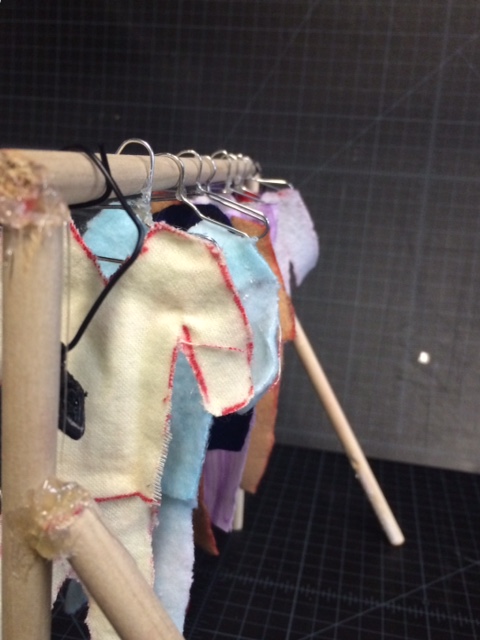
The aspect my group was assigned to was characters. We chose to represent this with a clothing rack with the characters’ outfits on them. In our opinion, clothes are an extremely important part of a character and are vital even more so in theater because not only can it help you tell apart the different characters but also, because often times, the the clothing says something about who the character is. Costumes are really essential to different characters, and are what set each character apart.

The roles we thought tied together most with this item were costume designers and actors. Costume designers would be the ones designing and making the costumes for the actors who would be wearing them during the performance. Moreover, costumes really help actors get into character and could make a huge difference in their mind set during the performance. There could be some causes for concern however, so we listed out what those could be as well as solutions to these problems.


A costume designer needs to make sure that the outfits they design fit the time period and look realistic, so our group did research on clothing in that time period. They also need to measure the actors so that everything fits correctly. Another important thing they would need is materials, so we made sure that they would be provided to them. Lastly, they would need for the clothes to not tear and rip easily so these costumes would need to made from good materials.

An actor will require comfortable clothes so it will be important that the right materials are chosen for the costumes. Furthermore, to help keep everything organized and to avoid mix ups labels with the name of the character will be sewn on the inside of the costume. Aside from that, it is important that the clothing fits, so they will need to be custom made and fitted. Another potential issue was the rack being bulky, so we decided to make the rack large enough for both the costumes and some extra space. This way they can easily find their costume and they can quickly put on, or take off, clothing from the rack.

All needs into consideration resulting in this rack. We found a good height for the model, 9.5 inches, because it would allow for bigger clothes than if we were to build a smaller rack. In real life we imagined it to be about 6.5 feet. We also made sure to add one hanger per character. We also wrote out, on a separate page, what the clothes would look like for each character, and added sketches for some of them. We chose which colors we wanted for the clothing, as well.

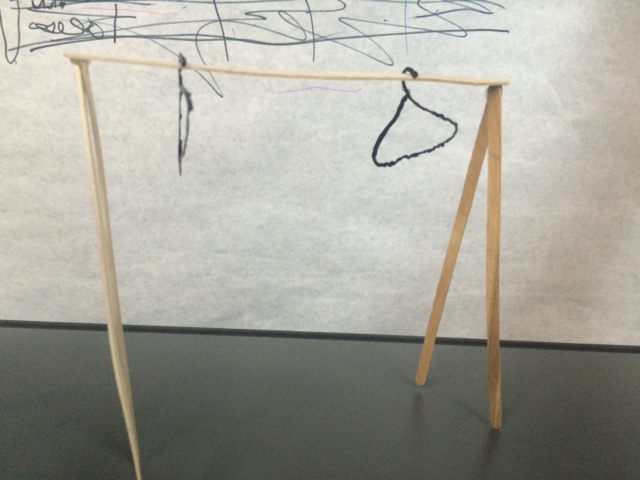
GS Prototype Rack (2015)
JF Costumes Sketch (2015)
The first model was made out of thin sticks that we had available in class. The hangers were made using the 3Doodler, which is a pen that draws with plastic. Thanks to this we were about to make the hook part of the hanger any size we wanted, so we made it perfect size for fitting the rack. However, this took too much time and the hangers were flimsy so we decided to use paper clips instead that we could bend to the shape we wanted, with the help of pliers. We also decided to change what the rack was made of and chose to use dowels instead. This made the model both more aesthetically pleasing and sturdier.

JF Prototype (2015)
GS Prototype II (2015)
The sketch and first model were a great start but there was still a lot more we needed to fix. We decided to make a pros cons list to help us decide which ideas were good and wanted to include in our final model.


Our final model has some things that our first model and sketch did not. We made sure to incorporate the good things from the original racks onto our final racks. This resulted in a sturdier and much nicer looking model.

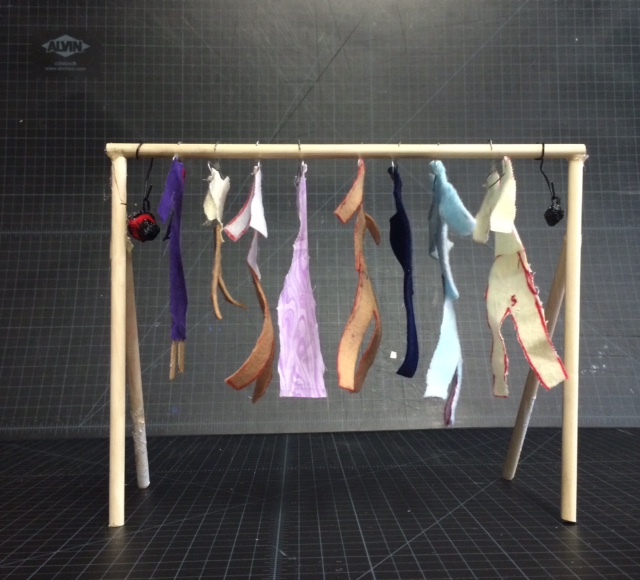
GS Costumes on Rack (2015)
For our last model, we added two hooks for somewhere to place the hats. We also actually made the clothes which we had not done before. There was one for each character, and we made it based on the actors size (for example, Tiny Tim is much smaller so his clothes are, too). This shows all the clothes were fitted correctly and custom made.

GS Costumes on Rack II (2015)
The fabric used for the model represent much nicer fabric in real life. We made things different colors to represent the different cloth and materials the costume designer would be using.

GS Costumes on Rack III (2015)
As shown, each costume is quite different and made from different colors. We tried to make the costumes represent what kind of a person the character was. Scrooge was in pajamas that we made beige, because of his bland personality. Marley was also in pajamas but his were light blue, so that the audience could tell the two of them apart. For the Ghost of the Past, we made a dress out of swirling purple colors. We chose this for her because we wanted her to seem gentle and kind because in the past Scrooge was a nicer person than who he was now. The Ghost of the Present was dressed as a protester, we used just a brown material but envisioned him to have a sign on his shirt as well. We made him a protester because of the time period that this was set in. We gave the Ghost of the Future the typical dark cloak to make him seem scary and mysterious. Bob and Tiny Tim both have just a shirt and pants that we imagined to be raggedy in real life. Tiny Tim also had a little cap. Our last character, Fred, wore a long coat to keep him warm in the winter, with a red sweater underneath, and a cap. We chose this outfit for him to show that he was wealthy enough to afford winter clothes unlike Bob and Tiny Tim, and because red reflects his cheery personality.

The project was done entirely during class time where we brainstormed and then built. After recording everything here is the time-lapse video of the entire process.

Friday, December 19, 2014

Model Stage

In our second Stage Chemistry unit, we learned about how different motion happens on the stage and the safety protocols to help accomplish them. This required not only looking at what happens on stage but also above and under the stage. We went to see A Christmas Carol at the Goodman Theatre. Then for our second action project we were to build a model of out own theaters that we made blueprints of in unit one (see here), for our own performance of A Christmas Carol. We also had to design two pieces of motion for the performance and safety protocols for them. I’m proud of both of the motion pieces I made because they required me to think more, so I was proud when I succeeded to make the models of them.

AG Empty Room (2014)
AG Room With Movement (2014)

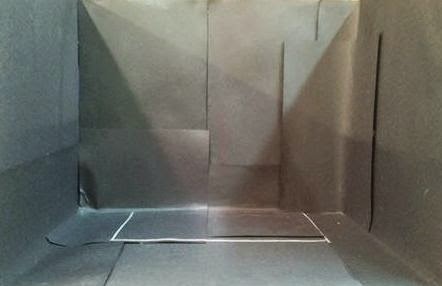
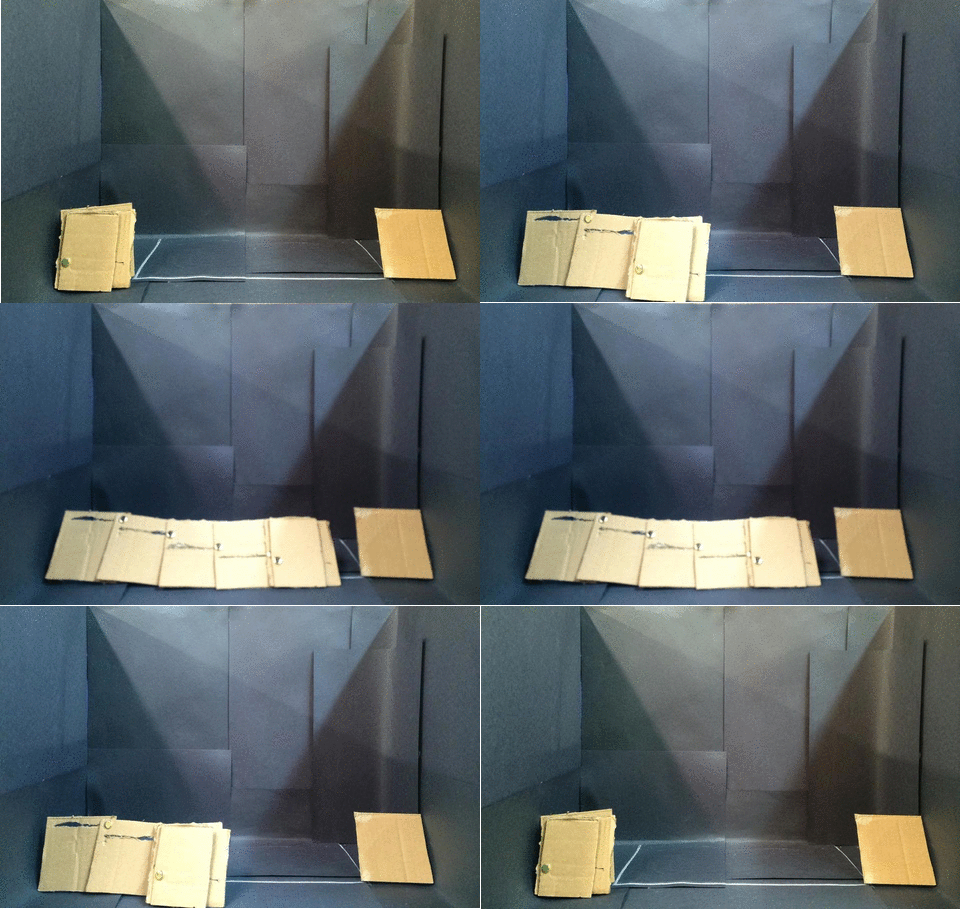
On the top is an image of the room and stage area alone; on the bottom is an image of the room with all the different parts.

AG Deck Gif (2014)


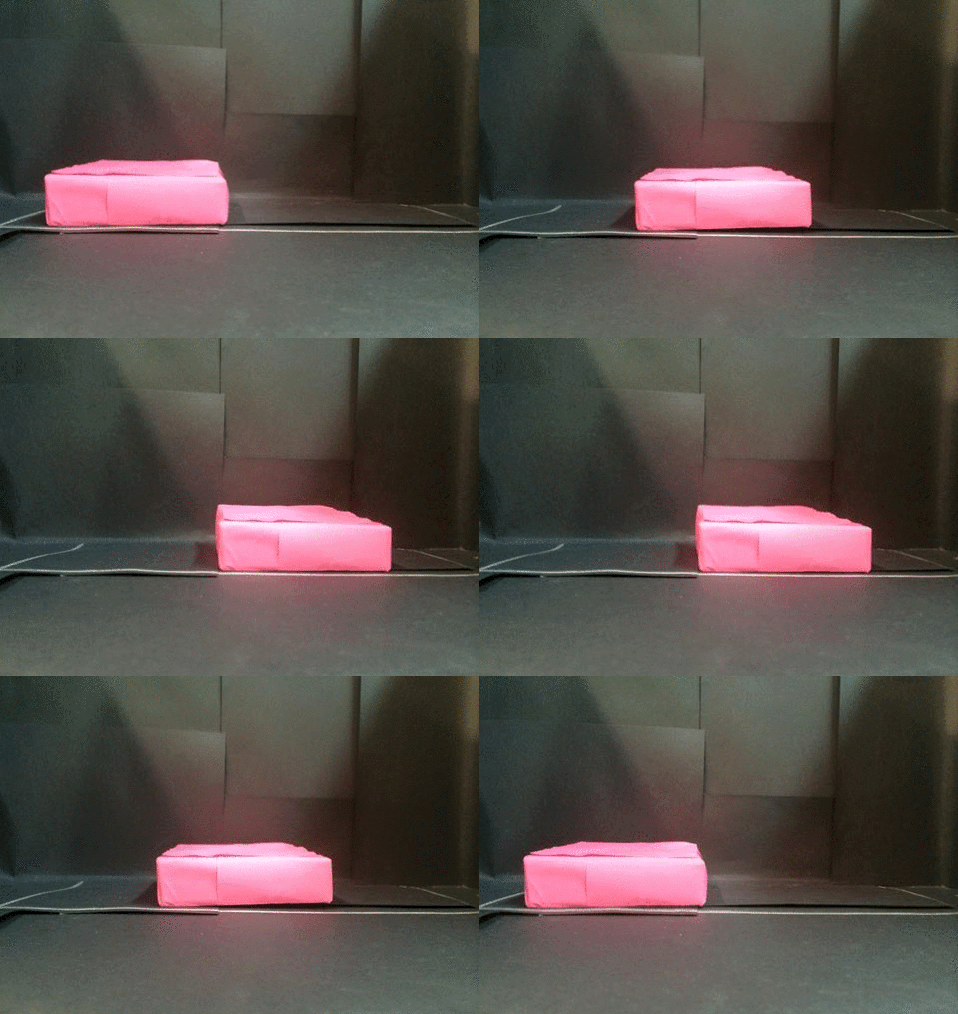
The moving deck is to show a setting. On it will be Scrooge’s house which is used in many scenes. It will be similar to the Goodman Theatre’s version of Scrooge’s house, where the left side shows the outside of the house, and the right part it Scrooge’s bedroom. However, it will be decorated differently. The deck will be towards the back of the stage so when it isn’t being used, a screen with different scenery painted on can be put in front of it.

AG Deck Warning (2014)
The Safety Protocols for the Moving Deck are:
  • If you are near the track (while it is still) be careful not to get anything stuck in it
  • Watch deck while pushing controls so that not to make it move while someone is in front of it
  • Be careful not to fall off deck
  • The deck is set to not go fast - do not try to change the speed
  • There will be an emergency button to kill the engine - be aware of how to use it
The deck is mechanical and has a motor to make it move. There will be a control in the backstage area so someone has the power to make it move back and fourth. The control will have a safety warning on the back as well.


AG Force Calculations (2014)

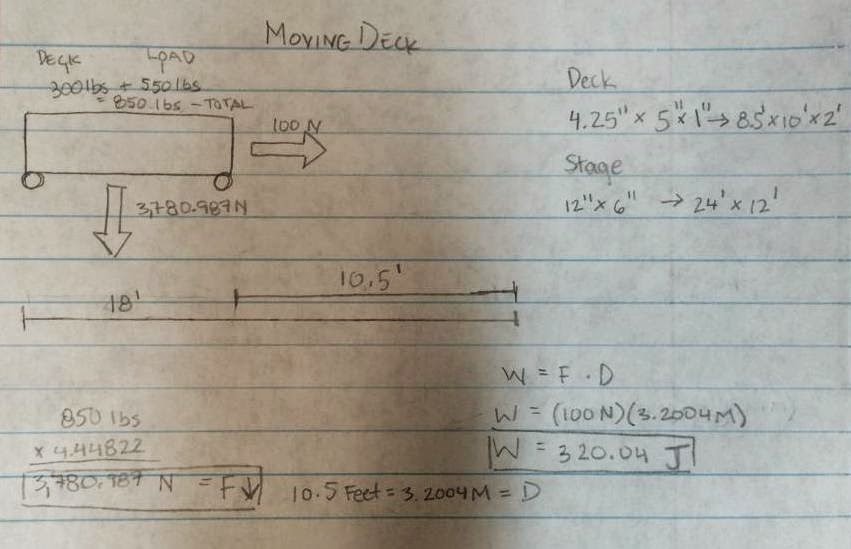
The deck will need to hold three people at most, with the expectation of around 550 lbs maximum, so it will be designed to hold twice that, 1100 lbs.

AG Bottom of Deck (2014)
AG Deck With Track (2014)
AG Deck In Trap (2014)
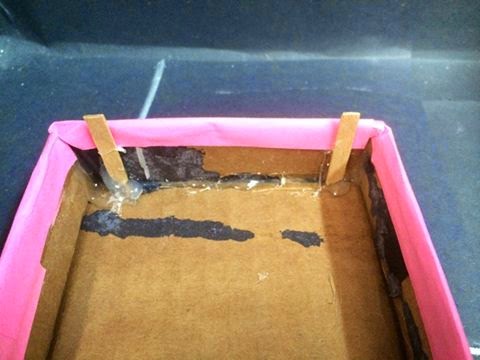
The model of the moving deck has two cut popsicle sticks on the back side. One on the left the other on the right. They stick out about a centimeter. In real life these are called the knives. On the model, those sticks insert into a slit in the stage model which represents the track. This is what keeps the deck in place and from going too far.

AG Divider Gif (2014)

The dividers have two main purposes. The first is that they hide off the area that isn’t considered the stage, which provides for a backstage area. The second purpose is it works as a curtain. If you pull the divider out, it hides the stage area just like a curtain would. It won’t be done mechanically; someone will pull it out themselves.

AG Divider Warning (2014)
The Safety Protocols for the Dividers are:
  • Watch your fingers
  • Be careful where you are rolling the dividers
  • Be careful not to knock dividers over since they are light

Monday, December 15, 2014

Psyched about Psycho

For our second Ollywood unit, we learned about what goes into the production of a film and how the movies are filmed exactly. We learned about different lighting techniques and framing angles. Aside from the filming, we also learned about what makes an actor’s performance good or bad. For our action project, we were to watch a movie and create a video critique with a group. My group chose to watch Psycho, the 1960 classic thriller directed by Alfred Hitchcock. In the critique, we discussed some pre-production and production elements, including plot, characters, set design, framing, lighting, and our personal opinions of the film.


Works Cited
  • A Picture of Great Significance. The Cine-Tourist. N.p., n.d. Web. 14 Dec. 2014.
  • Agnes, Racskay. Van Mit Nézni a Tévében? Heti Filmajánló. Nyugat.hu. N.p., 21 Oct. 2013 Web. 14 Dec. 2014.
  • Cooper, Rich. 15 Bathroom Nightmares Everyone Has. Student Beans. N.p., 12 Dec. 2013 Web. 14 Dec. 2014.
  • Elizabeth Hot Stuff. Elizabeth Hot Stuff. N.p., n.d. Web. 14 Dec. 2014.
  • Gif Blanco Y Negro De Halloween Clásica Película De Terror. - Gifmambo. N.p., n.d. Web. 14 Dec. 2014.
  • Super Showdeo Sunday! Today! Yee-Haw! - Cactus Thorns. Super Showdeo Sunday! Today! Yee-Haw! - Cactus Thorns. N.p., n.d. Web. 14 Dec. 2014.
  • What Hobby Did Norman Enjoy? - The Psycho Trivia Quiz. - Fanpop. N.p., n.d. Web. 14 Dec. 2014.
  • What We Can Learn from Psychopaths. DailyXY – Guy Stuff. N.p., 9 Jan. 2013 Web. 14 Dec. 2014.