Subjects

Showing posts with label Stage Chemistry. Show all posts

Friday, January 16, 2015

Costumes For Days

For our final Stage Chemistry unit, we made our own adaptation of A Christmas Carol. We were put into groups as opposed to working individually and, instead of focusing on the staging area, we focused more on what goes into the actual play. Each group got their own aspect, and they had to choose two or three roles that have vested interest in our aspect. We then had to build an item that represents these roles and their needs. We learned about the different roles there are in the theater and I was proud of how my group and I represented our roles. 

The aspect my group was assigned to was characters. We chose to represent this with a clothing rack with the characters’ outfits on them. In our opinion, clothes are an extremely important part of a character and are vital even more so in theater because not only can it help you tell apart the different characters but also, because often times, the the clothing says something about who the character is. Costumes are really essential to different characters, and are what set each character apart.

The roles we thought tied together most with this item were costume designers and actors. Costume designers would be the ones designing and making the costumes for the actors who would be wearing them during the performance. Moreover, costumes really help actors get into character and could make a huge difference in their mind set during the performance. There could be some causes for concern however, so we listed out what those could be as well as solutions to these problems.


A costume designer needs to make sure that the outfits they design fit the time period and look realistic, so our group did research on clothing in that time period. They also need to measure the actors so that everything fits correctly. Another important thing they would need is materials, so we made sure that they would be provided to them. Lastly, they would need for the clothes to not tear and rip easily so these costumes would need to made from good materials.

An actor will require comfortable clothes so it will be important that the right materials are chosen for the costumes. Furthermore, to help keep everything organized and to avoid mix ups labels with the name of the character will be sewn on the inside of the costume. Aside from that, it is important that the clothing fits, so they will need to be custom made and fitted. Another potential issue was the rack being bulky, so we decided to make the rack large enough for both the costumes and some extra space. This way they can easily find their costume and they can quickly put on, or take off, clothing from the rack.

All needs into consideration resulting in this rack. We found a good height for the model, 9.5 inches, because it would allow for bigger clothes than if we were to build a smaller rack. In real life we imagined it to be about 6.5 feet. We also made sure to add one hanger per character. We also wrote out, on a separate page, what the clothes would look like for each character, and added sketches for some of them. We chose which colors we wanted for the clothing, as well.

GS Prototype Rack (2015)
JF Costumes Sketch (2015)
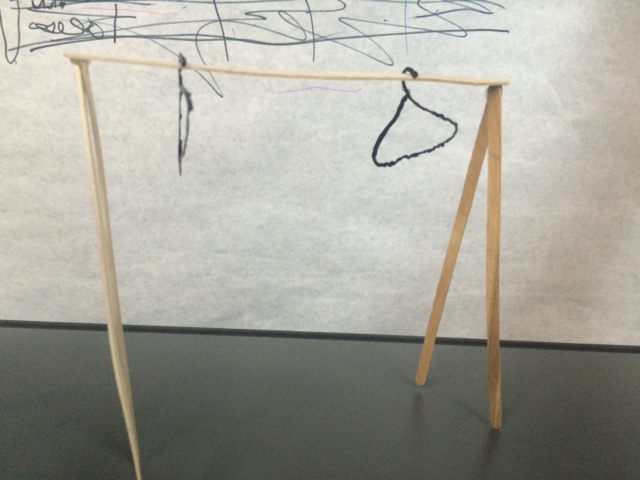
The first model was made out of thin sticks that we had available in class. The hangers were made using the 3Doodler, which is a pen that draws with plastic. Thanks to this we were about to make the hook part of the hanger any size we wanted, so we made it perfect size for fitting the rack. However, this took too much time and the hangers were flimsy so we decided to use paper clips instead that we could bend to the shape we wanted, with the help of pliers. We also decided to change what the rack was made of and chose to use dowels instead. This made the model both more aesthetically pleasing and sturdier.

JF Prototype (2015)
GS Prototype II (2015)
The sketch and first model were a great start but there was still a lot more we needed to fix. We decided to make a pros cons list to help us decide which ideas were good and wanted to include in our final model.


Our final model has some things that our first model and sketch did not. We made sure to incorporate the good things from the original racks onto our final racks. This resulted in a sturdier and much nicer looking model.
GS Costumes on Rack (2015)
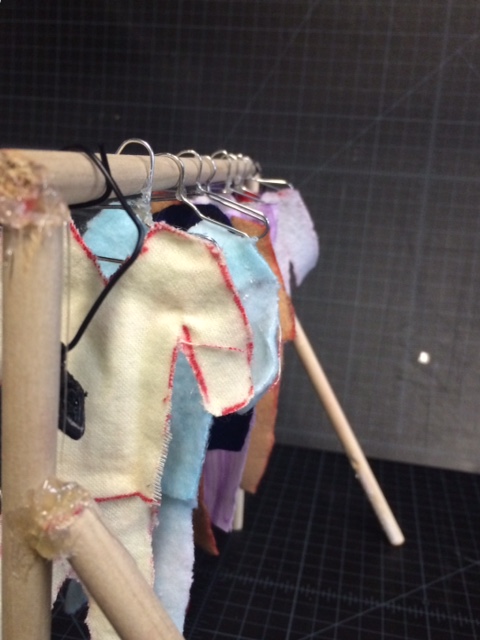
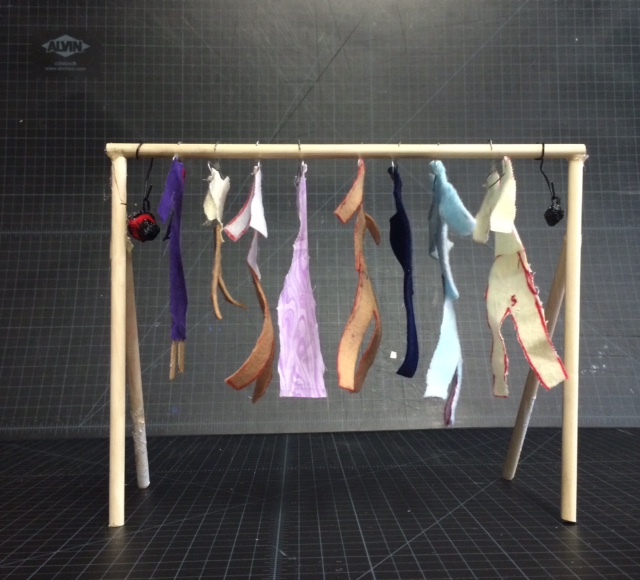
For our last model, we added two hooks for somewhere to place the hats. We also actually made the clothes which we had not done before. There was one for each character, and we made it based on the actors size (for example, Tiny Tim is much smaller so his clothes are, too). This shows all the clothes were fitted correctly and custom made.

GS Costumes on Rack II (2015)
The fabric used for the model represent much nicer fabric in real life. We made things different colors to represent the different cloth and materials the costume designer would be using.

GS Costumes on Rack III (2015)
As shown, each costume is quite different and made from different colors. We tried to make the costumes represent what kind of a person the character was. Scrooge was in pajamas that we made beige, because of his bland personality. Marley was also in pajamas but his were light blue, so that the audience could tell the two of them apart. For the Ghost of the Past, we made a dress out of swirling purple colors. We chose this for her because we wanted her to seem gentle and kind because in the past Scrooge was a nicer person than who he was now. The Ghost of the Present was dressed as a protester, we used just a brown material but envisioned him to have a sign on his shirt as well. We made him a protester because of the time period that this was set in. We gave the Ghost of the Future the typical dark cloak to make him seem scary and mysterious. Bob and Tiny Tim both have just a shirt and pants that we imagined to be raggedy in real life. Tiny Tim also had a little cap. Our last character, Fred, wore a long coat to keep him warm in the winter, with a red sweater underneath, and a cap. We chose this outfit for him to show that he was wealthy enough to afford winter clothes unlike Bob and Tiny Tim, and because red reflects his cheery personality.

The project was done entirely during class time where we brainstormed and then built. After recording everything here is the time-lapse video of the entire process.

Friday, December 19, 2014

Model Stage

In our second Stage Chemistry unit, we learned about how different motion happens on the stage and the safety protocols to help accomplish them. This required not only looking at what happens on stage but also above and under the stage. We went to see A Christmas Carol at the Goodman Theatre. Then for our second action project we were to build a model of out own theaters that we made blueprints of in unit one (see here), for our own performance of A Christmas Carol. We also had to design two pieces of motion for the performance and safety protocols for them. I’m proud of both of the motion pieces I made because they required me to think more, so I was proud when I succeeded to make the models of them.

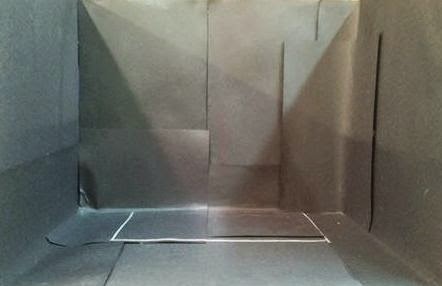
AG Empty Room (2014)
AG Room With Movement (2014)

On the top is an image of the room and stage area alone; on the bottom is an image of the room with all the different parts.

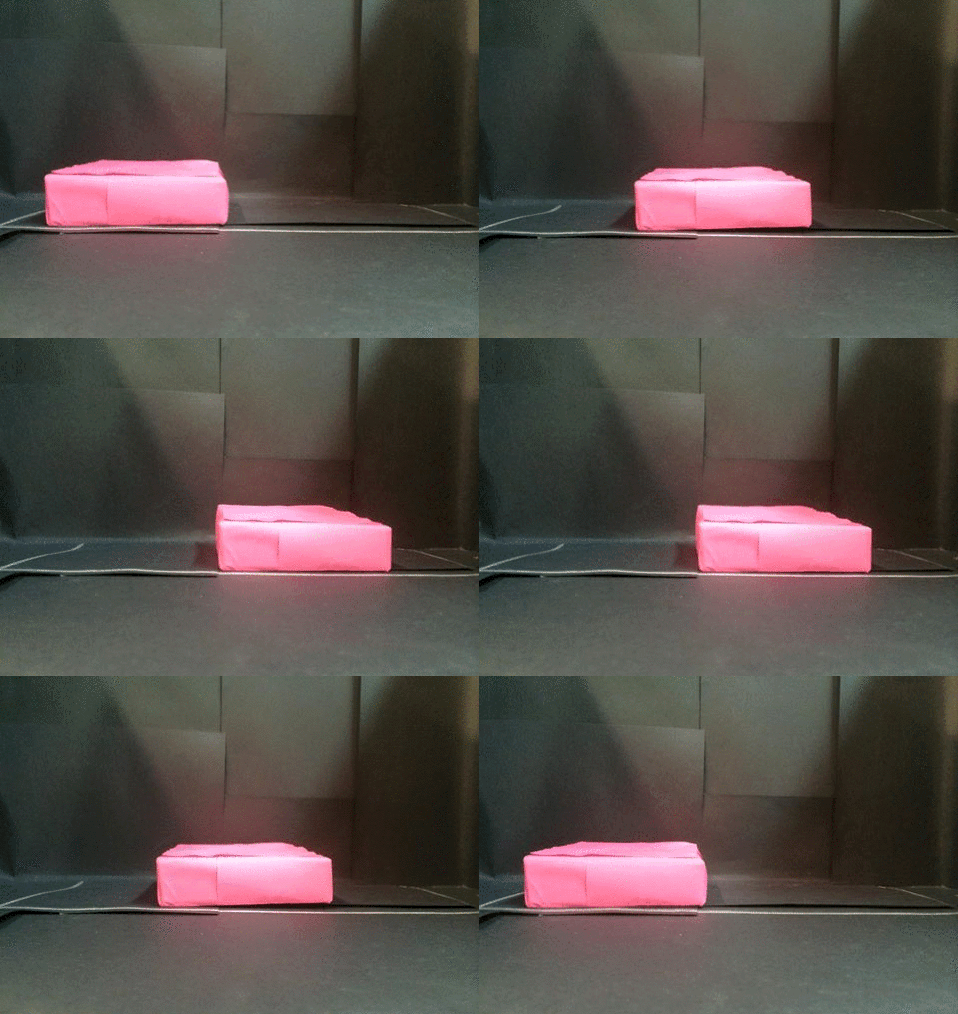
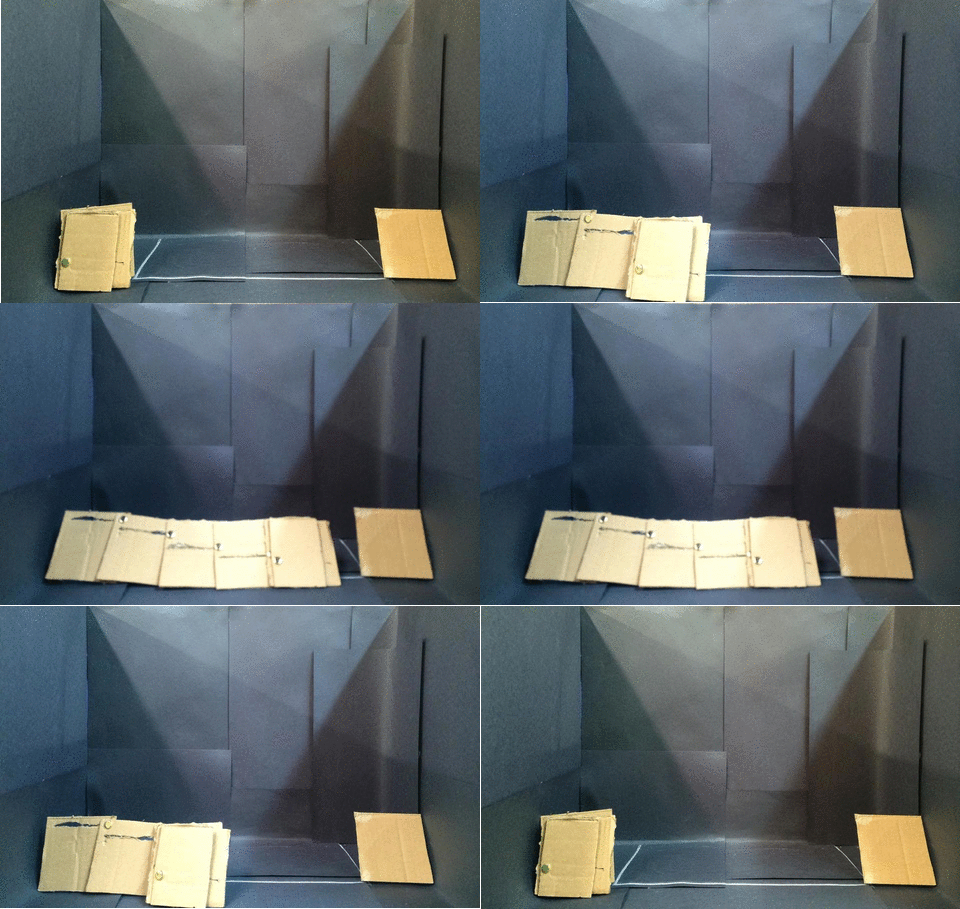
AG Deck Gif (2014)


The moving deck is to show a setting. On it will be Scrooge’s house which is used in many scenes. It will be similar to the Goodman Theatre’s version of Scrooge’s house, where the left side shows the outside of the house, and the right part it Scrooge’s bedroom. However, it will be decorated differently. The deck will be towards the back of the stage so when it isn’t being used, a screen with different scenery painted on can be put in front of it.

AG Deck Warning (2014)
The Safety Protocols for the Moving Deck are:
  • If you are near the track (while it is still) be careful not to get anything stuck in it
  • Watch deck while pushing controls so that not to make it move while someone is in front of it
  • Be careful not to fall off deck
  • The deck is set to not go fast - do not try to change the speed
  • There will be an emergency button to kill the engine - be aware of how to use it
The deck is mechanical and has a motor to make it move. There will be a control in the backstage area so someone has the power to make it move back and fourth. The control will have a safety warning on the back as well.


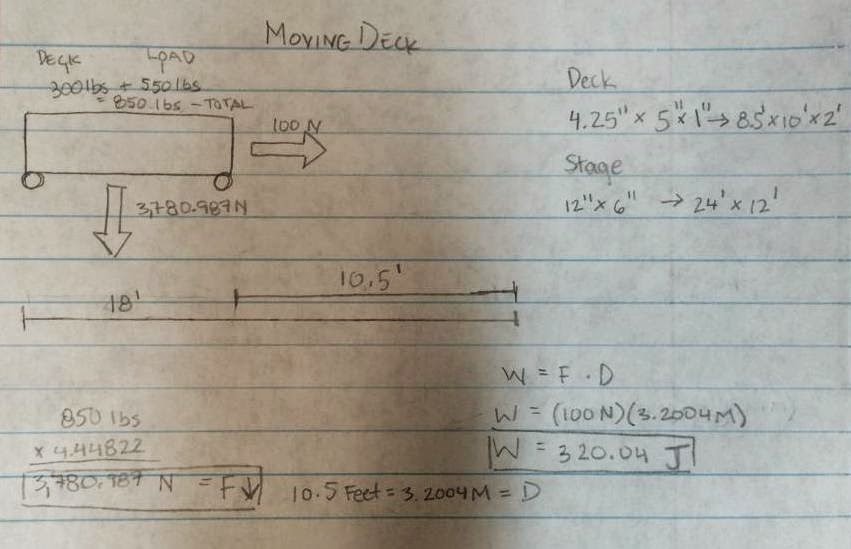
AG Force Calculations (2014)

The deck will need to hold three people at most, with the expectation of around 550 lbs maximum, so it will be designed to hold twice that, 1100 lbs.

AG Bottom of Deck (2014)
AG Deck With Track (2014)
AG Deck In Trap (2014)
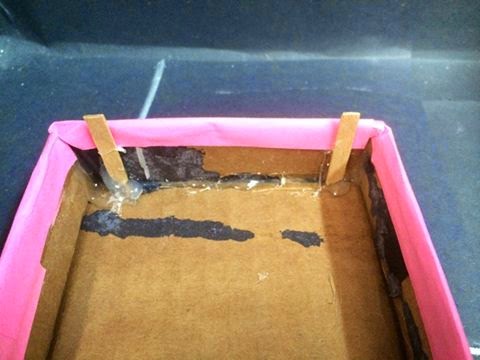
The model of the moving deck has two cut popsicle sticks on the back side. One on the left the other on the right. They stick out about a centimeter. In real life these are called the knives. On the model, those sticks insert into a slit in the stage model which represents the track. This is what keeps the deck in place and from going too far.

AG Divider Gif (2014)

The dividers have two main purposes. The first is that they hide off the area that isn’t considered the stage, which provides for a backstage area. The second purpose is it works as a curtain. If you pull the divider out, it hides the stage area just like a curtain would. It won’t be done mechanically; someone will pull it out themselves.

AG Divider Warning (2014)
The Safety Protocols for the Dividers are:
  • Watch your fingers
  • Be careful where you are rolling the dividers
  • Be careful not to knock dividers over since they are light

Tuesday, November 25, 2014

Performance at Fasseas

For our first unit of Stage Chemistry, we learned about the different elements of a theater. We learned about measuring and scaling correctly. For our first action project, we were asked to take our newfound knowledge and apply it to a space of our choice; when then turned that space into a theater. I chose to use Menomonee, specifically Fasseas for the room with the stage. To help us with ideas we examined the Goodman Theatre and its elements. We then had to chose six of our own elements to show details of our space. The elements I chose were the stage, the viewing angles, the lobby showing how to get to the bathrooms, the coat check and concessions, the box office, and ticket pricing. I also had a blueprint of the entire area, as well as a comparison between my space and Goodman Theatre's. I really enjoyed the math parts of the project and making the blueprint to scale. It was difficult to measure all the walls and draw them to scale, because some of the walls weren't at a 90 degree angles. However, I ended up finding a good estimate that worked perfectly, which I was proud of accomplishing.